Istanbul, with its rich history, is one of the cities that attracts the most tourists. A historical city that has hosted three empires, it's impossible to see all the historical sites within its walls. There are also historical buildings and places in Istanbul that we pass by countless times without noticing.
Here are some historical sites and landmarks in Istanbul that we might pass by without noticing.
Million Stone
The Million Stone, which those visiting Sultanahmet have passed by at least once, is an important historical heritage that is as old as Istanbul and has witnessed the history of Istanbul.
The Milion Stone, a monument dating back to the 4th century during the Eastern Roman period, was considered the starting point of all ancient Roman roads leading to Constantinople in the Byzantine Empire, and the zero point used to calculate the distance of other cities in the world from this city. Located in Sultanahmet, this historical column sits on the tram line near the Basilica Cistern.
Sogukcesme Street
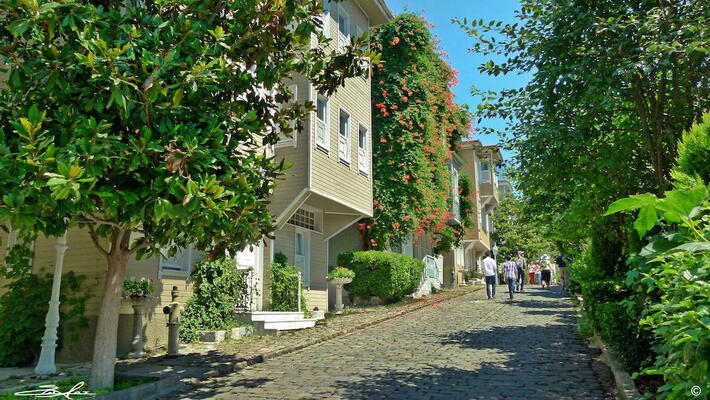
Soğukçeşme Street, with its historic houses adorned with cobblestones, bears witness to Istanbul's past.
This street, dating back to the reign of Selim III, is an important historical landmark. It's one of Istanbul's lesser-known beauties, and takes its name from a Turkish fountain that existed there at the time. Located in the Sultanahmet district of Istanbul, Soğukçeşme Street is situated near Hagia Sophia, Topkapi Palace, the Sultan's walls, and features 12 houses and a Roman cistern.
This street, which is now closed to vehicle traffic, is a must-see if you live in Istanbul.
German fountain
The German Fountain, a mosaic-decorated fountain in Istanbul.
Located in Istanbul's Sultanahmet district, the German Fountain is a gift from German Emperor Wilhelm II to Istanbul. Designed in the Neo-Byzantine style, its interior is decorated with mosaics. The fountain, originally built in Germany, sits on foundations here. The marble and precious stones were processed in Germany and transported to Istanbul in pieces by ship.
Church of the First of the Month
The Church of the First of the Month, where wishes are believed to come true!
The Church of the First of the Month, which opens its doors to those wishing to have their wishes fulfilled on the first of each month, is a place visited not only by Christians but also by Muslims seeking the fulfillment of their wishes. Located in the Unkapanı district and known by the public as the Church of the First of the Month, its real name is the Church of the Virgin Mary.
Ahi Çelebi Mosque
The Ahi Çelebi Mosque is the mosque that witnessed Evliya Çelebi's dream!
Located in Eminönü, the Ahi Çelebi Mosque is among the mosques that witnessed the most glorious periods of the Ottoman Empire. Known as the mosque where Evliya Çelebi had his famous travel dream, the Ahi Çelebi Mosque was described by Çelebi as "a mosque built with halal money." What makes the Ahi Çelebi Mosque significant for Evliya Çelebi is that his famous dream took place there. In his dream, he sees himself filled with a radiant congregation, which he describes as being composed of the spirits of prophets and saints. ”He shows Abu Bakr, Ali, Osman, Omar, Veysel Karani, Bilal al-Habashi, and Hamza. At that moment, Prophet Muhammad enters the mosque with Hasan on his right and Hussein on his left. After the morning prayer led by Prophet Muhammad, Evliya Çelebi reads the Quran. Then the person next to him takes his hand, and that famous scene occurs. He kisses the hand of Prophet Muhammad and instead of saying "Intercession, O Messenger of Allah," he says "Travel, O Messenger of Allah." Prophet Muhammad smiles and says, "O Allah, make intercession, travel, and visitation easy with health and inspiration." The radiant crowd leaves the mosque, and Çelebi wakes up.” Thus, Evliya Çelebi's desire to travel is ignited, and he writes his famous Travelogue. The Ahi Çelebi Mosque, also known as the mosque where the Prophet prayed and led the morning prayer, was rendered unusable by fires in Yemiş İskelesi in 1539 and 1653. After the second fire, it was repaired by Architect Sinan and became one of the important structures of today.
Dungeon Inn
Zindan Han was actually an old prison.
The building, which served as a prison until the end of 1877, takes its name from the Baba Cafer Tomb located next to it and the dungeon within it. One of Istanbul's oldest historical buildings, Zindan Han, also known as the "ring of Istanbul," now serves as the luxurious SurPlus Restaurant. The building, which has caught the attention of almost everyone passing through Eminönü, was formerly known as a caravanserai where merchants who could not pay their debts were imprisoned.
Notre Dame De Sion French High School
Notre Dame, the oldest girls' high school in Istanbul, was converted into a private French high school by the Ottoman Empire in 1856. What makes this building interesting isn't just that it's the oldest high school in Istanbul; it's also a free art center. The school, which has hosted many artists, boasts a beautiful garden. We recommend spending some time in the garden, which is open to everyone, and enjoying a cup of tea.
Cağaloğlu bathhouse
Cağaloğlu Hamam is one of the largest double bathhouses in Istanbul. Built in the Baroque style during the reign of Mahmud I, its cold and hot sections are designed with features different from classical Ottoman architecture. With its small and large domes and a large central stone, the structure is an important architectural landmark. It was the last bathhouse built before the ban on bathhouse construction in 1768, and it has witnessed centuries of history, hosting many important sultans and pashas at its central stone.
Arasta Market
With its mosaic pendant lamps, hand-woven rugs and carpets, and the most magnificent ceramic works, Istanbul's Arasta Bazaar, known only to tourists, is definitely one of the must-see markets when visiting Sultanahmet.
The tourist bazaar known today as Arasta Bazaar, formerly called Sipahi Bazaar, is located on the south side of the Sultan Ahmet Complex. It was destroyed in major fires during the Ottoman period and remained in ruins for a long time. Occupied by shanty houses a few years ago, the bazaar was cleared and restored by the General Directorate of Foundations in the 1980s and reopened. Consisting of a long street lined with neatly arranged shops, the historical bazaar today sells hand-woven antique carpets and various tourist souvenirs.
Aydos Hill
Aydos Hill (Mountain), a hidden gem of Istanbul located at its highest point, takes its name from Roman and Byzantine times. According to one legend, its name comes from Damatrys, the goddess of agriculture. The hill, where you can watch the sunset against its magnificent view, also has a running track.